theenk Books
We
have an incredible new
anthology and it is
Available
NOW,
Hooray!
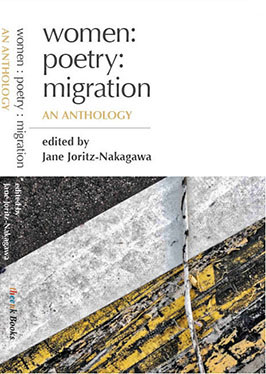
Women
: Poetry : Migration, an anthology
Edited by Jane Joritz-Nakagawa
Along
with five other new titles forthcoming in 2018
FREE
Shipping for ALL
theenk
Books titles through
April Poetry Month!
New book by Judith Roitman, Roswell, available NOW from theenk Books!
Available
NOW! Women
: Poetry : Migration, an
anthology (Edited by Jane Joritz-Nakagawa)
ADEENA KARASICK – AMANDA NGOHO REAVEY – ANDREA BRADY – ANGELA CARR – ANIA WALWICZ
    ANNE TARDOS – BARBARA BECK – BELLA LI – CARRIE ETTER – CECILIA VICUÑA – CHRIS TYSH
       CIA RINNE – CRISTINA RIVERA GARZA – DONNA STONECIPHER – ÉIREANN LORSUNG – ZHANG ER
 FAWZIA AFZAL-KHAN – HAZEL SMITH – IVY ALVAREZ – JANE JORITZ-NAKAGAWA – JANE LEWTY
   JENNIFER K. DICK – JENNIFER KRONOVET – JI YOON LEE – JODY POU – LARESSA DICKEY – LEA GOLDBERG
     LEE ANN BROWN – LISA SAMUELS – M. NOURBESE PHILIP – MAIRÉAD BYRNE – MARCELA SULAK
        MEGAN M. GARR – MICHELLE NAKA PIERCE – MONG-LAN – NANCY GAFFIELD – NATHANAËL
           NORMA COLE – PATRICIA DEBNEY – WANG PING – RACHEL TZVIA BACK – ROSMARIE WALDROP
  RULA JURDI – SAFAA FATHY – SASCHA AURORA AKHTAR – SHARMILA COHEN – SHEIDA MOHAMADI
      SUN YUNG SHIN – TSITSI JAJI – YUKO OTOMO
Exile (to echo Edmond Jabès) is a fundamental condition of poetry.These 50 poets make diaspora home ground. They are the lightning rods of a non-national poetry of “between” that pushes against nativism through sheer aesthetic exuberance and necessity of innovation. – Charles Bernstein
Women: Poetry: Migration is a superb, refreshing anthology. As nationalism and the rigidity of territorial and linguistic boundaries, under challenge, erode, this anthology of poetry by women provides a wide-ranging and innovative look at this migratory time in the writing of poetry. Migratory in terms of place and the changing nature of location, undergoing challenge and redefinition in terms of gender identity, and in transit as a polylingual consciousness and multilingual ways of writing become more and more evident. My congratulations to the editor for her vision, imagination, and persistence, and to the women who have contributed such remarkable writing to the anthology. – Hank Lazer
Jane Joritz-Nakagawa has undertaken a remarkable editorial task in bringing together avant-garde women poets who are also migrants. If, as Susan Suleiman wrote, the avant-garde woman poet is doubly marginalised, then these poets are in a triple lock of marginalisation. Yet, as the anthology demonstrates, this can be a source of strength and transformation, which gives them a centrality, not only in their own lives, but in the cultural development of their adopted country. Indeed, some of these poets have played a crucial role in shaking up mainstream poetics. – Frances Presley
“On google earth I write down my name,” writes Ania Walwicz
in this ecstatic anthology, Women : Poetry : Migration. With
sharp eye and ear, Jane Joritz-Nakagawa has gathered arresting, often
experimental, poetry by women living outside the lands of their birth.
These are poems where the “trans” – translation; transculture;
transformation – inhabits the unsettling language of identity
and location, with multiplicity, cosmopolitanism and the “push
and pull” (Bella Li) of writing desire. Every page offers shifts
of imagery or perspective as witness to embodiment, alterity, and hybridities
of language. In the plural worlds of the poets, we hear how border crossing
constructs a life (Fawzia Afzal-Khan) and “utopianism” always
“goes wrong” (Donna Stonecipher).
– Anne Elvey
“Where am I going? I am getting there.” Amanda Ngoho Reavey’s words might serve as a motto for this wide-ranging, transnational anthology, which gathers 50 women poets who live in countries other than the ones in which they were born. This premise is the spark for an explosion of aesthetic experimentation that both maps and crosses boundaries of gender and nation. From the shuttling between Japan and Canada, Vietnam and Australia, or Zimbabwe and the United States, the authors gathered here elucidate a poetics formed in process. – Timothy Yu
My response to this collection is subjective, as I was once someone who lived and wrote for a while outside of my native land. In Women : Poetry : Migration, I could relive the excitement of pleasurable dislocation I felt some of the time I lived abroad. For instance, I liked experimenting or “deconsecrating” one language with another language to “make it clearer” (Jody Pou) and discovering through writing “what I don’t know” (Tsitsi Jaji). That said, this collection is open to any reader who is engaged by thoughtful, sensual, humorous and political ideas. In her essay in this anthology, Rosemarie Waldrop concludes, “If the poem works . . . it will set off vibrations in the reader, an experience with language – with the way it defines us as human beings.” I certainly felt the reverberation of language(s) as I read the poems and essays in this collection. It’s up to us as readers what we do next. – Deborah Richards
This anthology edited by Jane Joritz-Nakagawa is more than a poetic fact. It is a political fact because it presents to the public poets displaced from their countries and in conflict with their cultures. Perhaps this is the definition of poetry: art in conflict with languages and origins. Jane Joritz-Nakagawa offers to the reader double exiles: the exile of the tongue and the full "exile" of the female voice in patriarchal societies. Joritz-Nakagawa, in the words of the Brazilian modernist poet Oswald de Andrade, reinstitutes the "matriarchy of Pindorama." It is a work of breadth and rigor, which deserves attention and applause. As contributor Safaa Fathy states: “I write about what I lost.” Migrating is at the center of being a poet; this anthology also answers the question of what poetry is. And maybe this is what we ultimately gain from Joritz-Nakagawa’s anthology. – Régis Bonvicino
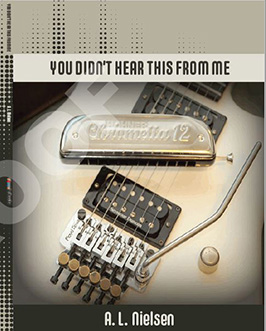
A.
L. Nielsen's YOU DIDN'T HEAR THIS
FROM ME
“The poems of A.L. Nielsen are self-organizing
networks. It is Brancusi’s duty to make skinny sculptures; it
is mine, & a pleasant one, to introduce A.L. Nielsen. We have been
silent partners for a decade in a scheme to overthrow mainstream discourse
& undermine exemplary sentences.”
– David Bromige
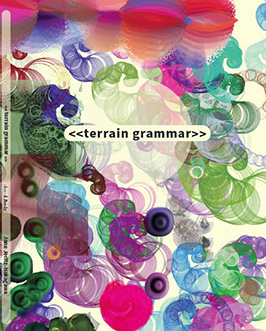
Jane
Joritz-Nakagawa's <<terrain
grammar>>
“Jane Joritz-Nakagawa refers in <<terrain
grammar>> to ‘images faster than an eye’: it
is an apt description of her own work. The poems are a high wire linguistic
act and are startlingly kinetic: images tumble on top of each other
in a dazzling interplay of interior and exterior dramas, creating ‘shifting
frames of reference.’ Including also a surreal narrative, some
meditations on the nature of poetry and insertions in Japanese, the
volume dismembers familiar patterns, reassembling them in unexpected
ways that suggest the overdrive of contemporary urban life but also
“dreamy landscapes with flowing boundaries.” –
Hazel Smith
“<<terrain grammar>> confronts us, reveals
us––clearing a pathway through the ‘silence
lattice/symbolic porn’ of its surreal lyricism
with the refractory force of an ineluctable exactitude. As one's engagements
with the poems in this exquisite collection accumulate, the fissures
and bulwarks of Joritz-Nakagawa's uncanny juxtapositions frame the ‘pain
that exceeds language’ –
an oblique glance at all that only is so far as it remains unnamed.
In this way, she invents a poetics ‘of unfathomed
archetypes/as a rigid joint,’ pulsing and
plunging through the carcass of language to unconceal the traces of
a world that is not ever in-itself. It is a brilliant, ecstatic work,
a work that rewards multiple readings with an ever more concise transformation
of quotidian vestiges into ‘a mask of divided
dwellings,’ thus the reader assumes the
role of ‘perpetual witness’
to the dissembled declination of those corporeal mechanics by which
witness is made possible, then imperative, then real.”
– Steven
Seidenberg, author of Situ
“Crossing the ocean that divides East & West physically &
metaphysically, Jane Joritz-Nakagawa has earned herself a very special
quality as a writer. Her superbly agile & intuitive dexterity dealing
with poetic thought process & language show us the genuine sense
of freedom she enjoys. Her voice is clear, humble & strong. It is
a pure thrill to flow with her in this magnificent <<terrain
grammar>>.” – Yuko
Otomo
“Words are not mere objects,” Jane Joritz-Nakagawa writes
from Japan, where she has lived and worked for many years. In her latest
book of poetry, <<terrain grammar>>, words stir
and jar one another. They create landscapes, shifting territorial contexts
for each other. With its alternating stanzas and prose passages, fragments
and statements, ‘lime and rhyme,’
this brilliant hybrid terrain suggests the form of the Japanese haibun.
Is it syntax or sheer poetic necessity that most startles the reader
with ‘unfamiliar sensations?’
Fierce, discerning, vigilant, these words have much to say, shout, nudge
each other. And touch us with grace.” –
Norma Cole
Eric
Selland 's Object States
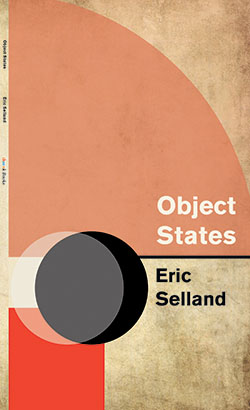
“No object that isn’t a state of mind or
being, no state of mind or being that doesn’t appear as an object,
an event, a thought, a phrase. This haunting philosophical impasse and
delight is the subject of Eric Selland’s quietly beautiful book
in which nearly every echoing sentence invites pondering. ‘The
poet screaming inside a fish.’ ‘A day which is merely a
symptom.’ Do you know where or who you are?”
– Norman Fischer
“Eric Selland finds ‘invisible doors’ in spaces we
did not know existed but are pleased to meet. ‘Language is a city’
both east and west and at once familiar and unfamiliar in ‘the
absent presence of memory.’ A fine work both haunting and revelatory
from one of the most skillful of contemporary poets.” –
Jane Joritz-Nakagawa
Judith Roitman's Roswell
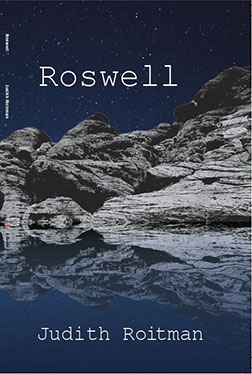
“Expertly depleted of grammar, these poems have
the effect of interlinear translations, literal glosses based on intelligence
just beyond the human. Roitman has isolated a pure signal whose terms
coalesce into media as tangible as the materials they stand for. Roswell
testifies to the existence of a poetry at the limit of words, a culture
just adjacent to the world, where facts remain.”
–
Cyrus Console
"Judith Roitman’s suite of documentary-poetic lyrics, Roswell,
parses elements of narrative fact/fallacy. Take-off point is New Mexico,
1947, intersection of flying saucer crash reports and coverups. Redacted,
randomized, resurrected texts jigsaw a story that is or could be. The
poet is storyteller for a script that continuously shapeshifts. Words
are reassigned in each moment of this essential collection."
– Denise Low, winner Red Mountain Editor’s
Choice Award
"What are we looking at? That is the question that Judith Roitman’s
fascinating Roswell poses to “eyewitnesses” and
readers alike. Whether through a narrative debris field of testimonies,
articles, and reports, or from the point of view of an abject alien
in the desert, that elusive 'it' is 'seen as wished for never more than
never recognized.' Ultimately, Roitman’s compelling poems are
about that which seems alien, other, only partially experienced, when
the 'positive malfunctioned.' In other words, this is a book about 2018
as much as 1947. You need to read it."
– Joseph Harrington, author of Of
Some Sky
Judith Roitman’s Roswell makes me wonder whether it’s
possible for humans to engage aliens without the former humanizing the
latter. The poems, after all, claim “surviving alien remembers
its descendants,” “surviving alien remembers nourishment,”
and so on as if the human Roitman can inhabit non-earthling point of
views. Such may be considered empathy. But for these poems relating
to 1947 events to come out in 2018 is also to emphasize how little empathy
is displayed today by the U.S. administration for “aliens”
of a different sort but within the same species. How far humanity has
fallen. These poems accomplish what good poems do: go beyond themselves
into other matters as they make the reader think.
– Eileen R. Tabios, author of Love
In A Time of Belligerence
Jim
McCrary's This HERE
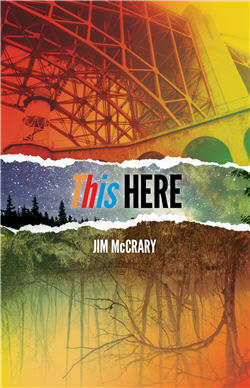 Jim
McCrary's This HERE
is a gorgeous collection of "lost wishes and found demands" that roots
down in Kansas, saunters through streets around the world, and wishes
to leave our universe to sing along with Sun Ra. At once cantankerous
and tender, these poems challenge the systems that contain us and our
everyday hearts to imagine what could be. McCrary's poems will charm
you; you won't be able to resist them. –
Megan Kaminski
Jim
McCrary's This HERE
is a gorgeous collection of "lost wishes and found demands" that roots
down in Kansas, saunters through streets around the world, and wishes
to leave our universe to sing along with Sun Ra. At once cantankerous
and tender, these poems challenge the systems that contain us and our
everyday hearts to imagine what could be. McCrary's poems will charm
you; you won't be able to resist them. –
Megan Kaminski
The obvious gold here includes recollections of days with Burrough's,
Corso, Acker, Dorn, Blackburn. Less obvious is how the whole reflects
the times as they are when it's likely that 2/3 of humans will be dead
in a hundred years, that within the next 30 years there will be no mammals
in the wild larger than a rat, that the seas will be full of one-celled
animals and jellyfish, et al. Thus, do we stumble over lines like "Desires
for public bombs that go bang on a screen / Then disappear, we think,
and thank again for good" or "you better open up and see / you can bet
in ti fada fada / gonna stand up over the big / fence you got" or "Page
three is lost / Page four is lost." Fortunately, there's poetry hear
and there's still a Page five [that] is spell bound. – Eileen
Tabios
Jennifer
Bartlett's Autobiography/Anti-Autobiography
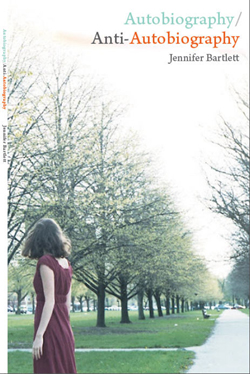 Jennifer
Bartlett was born in the San Francisco Bay Area and educated at the
University of New Mexico, Vermont College, and Brooklyn College. She
is the author of Derivative of the Moving Image (UNM Press
2007) and (a) lullaby without any music (Chax 2012). Bartlett
also co-edited, with Sheila Black and Michael Northen, Beauty is
a Verb: The New Poetry of Disability. Bartlett has received fellowships
from the New York Foundation for the Arts, Fund for Poetry, and the
Dodd Research Center at the University of Connecticut. She is currently
writing a full-length biography of the poet Larry Eigner. She lives
in Brooklyn, N.Y., with the writer Jim Stewart and their son, Jeffrey
Stewart.
Jennifer
Bartlett was born in the San Francisco Bay Area and educated at the
University of New Mexico, Vermont College, and Brooklyn College. She
is the author of Derivative of the Moving Image (UNM Press
2007) and (a) lullaby without any music (Chax 2012). Bartlett
also co-edited, with Sheila Black and Michael Northen, Beauty is
a Verb: The New Poetry of Disability. Bartlett has received fellowships
from the New York Foundation for the Arts, Fund for Poetry, and the
Dodd Research Center at the University of Connecticut. She is currently
writing a full-length biography of the poet Larry Eigner. She lives
in Brooklyn, N.Y., with the writer Jim Stewart and their son, Jeffrey
Stewart.
“A book must be the ax for the frozen sea within us.” We
all know this quote by Franz Kafka, but it is the rare book that is
sharp, wide, acute or beautiful enough to change or unfreeze us. Autobiography/Anti-Autobiography
is such a book—full of the strangeness and wonder of living—or
in Bartlett’s words, “o ocean, o place/o little blue house,
o gleaming.” For people with disabilities, Bartlett is Mary Woolstonecraft
and a poet whose every word rings with the fine edge of truth. –
Sheila Black
Autobiography is an at once in your face and reflects an account
of “crippled” embodiment. For instance, Bartlett writes
both “...the mother might/ say your child must be angry// because
you are disabled//so I told her, your child/must be angry//because you
are bitch” or, in a separate poem, “to be crippled means
to have/ access to people’s fear//of their own erosion.”
Anti-Autobiography tests the meaning of embodiment by removing
it. What remains is a collage of fragmented experiences and thoughts
in which Bartlett “too, know[s] what it is like to want to sit
in a chair of a certain color.” Hospitals figure prominently and
“frogs sing against the half-light” of impending loss. Throughout,
Bartlett moves seamlessly between highly lyricaland highly direct modes
of engagement. Questions, lists, blocks of prose, dates and addresses,
form a perfect, supportive tension on which the self, embodied or not,
floats. – Andrea Baker
Jane Joritz-Nakagawa's Distant Landscapes
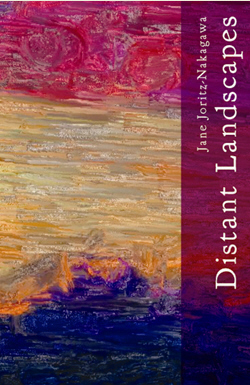 Originally
from the U.S., Jane Joritz-Nakagawa resides in central Japan. She is
the author of several books of poetry, chapbooks, and a broadside. Email
is always welcome at the following address: janejoritznakagawa@gmail.com
Originally
from the U.S., Jane Joritz-Nakagawa resides in central Japan. She is
the author of several books of poetry, chapbooks, and a broadside. Email
is always welcome at the following address: janejoritznakagawa@gmail.com
From notational forward, Jane Joritz-Nakagawa’s poetry has moved to a place in which the territory between poem and book have blurred, even as the writing and Joritz-Nakagawa’s perceptions have sharpened. Distant Landscapes demonstrates the deep and entirely pleasurable presences that become possible in this middle terrain. At core, Joritz-Nakagawa is more a descriptive poet, but without the austerity that so often accompanies that aesthetic, than a metaphoric one. My favorite moments – there are many – come when she builds a rapid fire linkage of seeming opposites into larger structures that feel deeply inevitable, like life itself. This is an excellent text to share with a lover in bed, or take with you for a walk in the forest. – Ron Silliman
Woman, forest, mountains, tree, rabbit, owl. Woman “marries the
tree but [has] sex with the river.” The elements of her isolation
redound and repeat, suggesting narratives and then taking them away.
Both tree and woman write verse. But even in this wood, “civilized”
world intrudes: “another beheading / another beheading,”
and the poet cannot separate forest from city streets. “Isolating
oneself in the mountains as I sometimes do is political (maybe a lot
of “emptying out” occurs there for me!) as is returning
to the city (it’s not a flight from people exactly that brings
me to the mountains but a flight from the commodification of cities
I suppose though I need space to think) for me.” There is nowhere
to rest on this pendulum, one Joritz-Nakagawa describes so well. So
hang on to a near branch and read! – Susan M. Schultz
Eileen R. Tabios' The Awakening
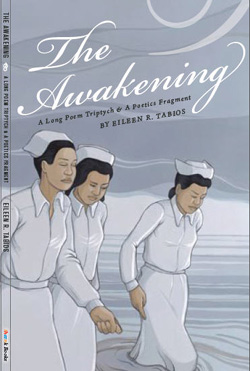 We
are very proud to announce the publication of Eileen R. Tabios'
The Awakening:
a triptych of long poems exploring the diverse ways an awakening unfolds.
Also included is an essay on the poet's personal perspectives on the
indigenous and the avant garde. The poems range over such disparate
elements as the sexual lives of painters (and discussing such details
with Dr. William Carlos Williams) to real-time emails on the poet's
"9-1-1" birthday after the attacks on New York's World Trade Center
to Angelina Jolie's involvement with refugees. The book's attention
span/expanse reflects Ms. Tabios' attempts to collapse time into a point
of universal empathy as the reader is asked: "Who decides what kind
of life and why? // What kind of / life and / Why?"
We
are very proud to announce the publication of Eileen R. Tabios'
The Awakening:
a triptych of long poems exploring the diverse ways an awakening unfolds.
Also included is an essay on the poet's personal perspectives on the
indigenous and the avant garde. The poems range over such disparate
elements as the sexual lives of painters (and discussing such details
with Dr. William Carlos Williams) to real-time emails on the poet's
"9-1-1" birthday after the attacks on New York's World Trade Center
to Angelina Jolie's involvement with refugees. The book's attention
span/expanse reflects Ms. Tabios' attempts to collapse time into a point
of universal empathy as the reader is asked: "Who decides what kind
of life and why? // What kind of / life and / Why?"
Eileen
R. Tabios has released 21 print, four electronic and 1 CD
poetry collections, an art essay collection, a poetry essay/interview
anthology, a short story book and a collection of novels. She has also
exhibited visual art and visual poetry in the United States and Asia.
Recipient of the Philippines’ National Book Award for Poetry,
she has crafted a body of work that is unique for melding ekphrasis
with transcolonialism. Her poems have been translated into Spanish,
Italian, Tagalog, Japanese, Portuguese, Polish, Greek, computer-generated
hybrid languages, Paintings, Video, Drawings, Visual Poetry, Mixed Media
Collages, Kali Martial Arts, Music, Modern Dance and Sculpture. She
also edited, co-edited or conceptualized nine anthologies of poetry,
fiction and essays as well as founded Meritage Press (St. Helena &
San Francisco). She is the editor of Galatea Resurrects,
a popular poetry review journal.
The Awakening, with its titular gesture boldly troping on Kate
Chopin, features Eileen Tabios' "Seance with William Carlos Willlams,"
one of the most powerfully feminist poems of her career. –
Thomas Fink
John
Roche's Road Ghosts
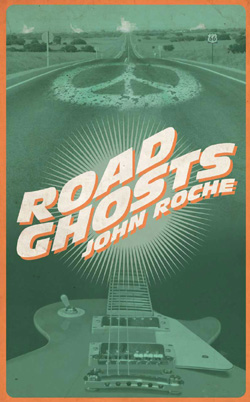 John Roche is an Associate
Professor of English at Rochester Institute of Technology, where he
advises the campus literary magazine, Signatures, and teaches
a variety of literature and creative writing classes. He earned a BA
from the University of Connecticut, Storrs, studying with George Butterick,
Charles Boer, and Glauco Cambon, an MA from University College Dublin,
and a PhD from SUNY Buffalo, studying with Robert Creeley and John C.
Clarke. He has been granted four National Endowment for the Humanities
fellowships and an SOS grant from the New York Foundation for the Arts.
His full-length poetry collections, Topicalities (2008) and
On Conesus (2005) are available from Foothills Publishing (Kanona,
NY). His poems have appeared in magazines like Yellow Medicine Review,
Flurb, House Organ, Big Bridge, Jack
Magazine, Interim, Intent, Coe Review,
The Woodstock Journal, Buff, The Burning World,
and in several anthologies. He also edited the collection Uncensored
Songs for Sam Abrams (Spuyten Duyvil, 2008), featuring poems by
Amiri Baraka, Ed Sanders, Bob Holman, Anne Waldman, Andrei Codrescu,
and other friends of the emeritus RIT professor. Dr. Roche sits on the
Board of BOA Editions, one of the nation’s leading non-profit
poetry presses. He co-edited, with Patricia Roth Schwartz, an anthology
of poetry by inmates at Auburn Prison called Doing Time to Cleanse
My Mind (FootHills Publishing, 2009).
John Roche is an Associate
Professor of English at Rochester Institute of Technology, where he
advises the campus literary magazine, Signatures, and teaches
a variety of literature and creative writing classes. He earned a BA
from the University of Connecticut, Storrs, studying with George Butterick,
Charles Boer, and Glauco Cambon, an MA from University College Dublin,
and a PhD from SUNY Buffalo, studying with Robert Creeley and John C.
Clarke. He has been granted four National Endowment for the Humanities
fellowships and an SOS grant from the New York Foundation for the Arts.
His full-length poetry collections, Topicalities (2008) and
On Conesus (2005) are available from Foothills Publishing (Kanona,
NY). His poems have appeared in magazines like Yellow Medicine Review,
Flurb, House Organ, Big Bridge, Jack
Magazine, Interim, Intent, Coe Review,
The Woodstock Journal, Buff, The Burning World,
and in several anthologies. He also edited the collection Uncensored
Songs for Sam Abrams (Spuyten Duyvil, 2008), featuring poems by
Amiri Baraka, Ed Sanders, Bob Holman, Anne Waldman, Andrei Codrescu,
and other friends of the emeritus RIT professor. Dr. Roche sits on the
Board of BOA Editions, one of the nation’s leading non-profit
poetry presses. He co-edited, with Patricia Roth Schwartz, an anthology
of poetry by inmates at Auburn Prison called Doing Time to Cleanse
My Mind (FootHills Publishing, 2009).
An unexpected treasure, Road Ghosts, is an on-the-ground poetic
document of radicalized students coming of age in the late '60s &
early '70s. Its clarity of external & internal detail is often startling.
Its detached camera eye lucidly documents the process of portent, pretense
& Utopian fervor associated with that brief opening in U.S. dissident
cultures & the generational clashes inspired by idealism, psychedelics,
& quest fever. It's a profound personal essay on being & becoming. –
David Meltzer
Stephen
Ellis'
O P U L E N C E
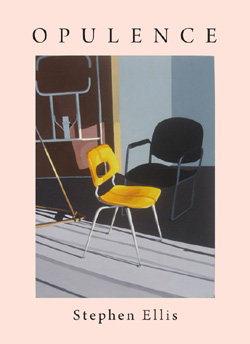 Like Olson on steroids! In this “pre-toxic frenzy
of Dionysian inhalation,” Ellis breaks out of the
chains of limiting categories, where all knowledge and experience
is free to roam where it will – “knowledge thus
a scattering of language.” Ellis’ poetry leaves
postmodern surface way behind, bringing us a poetry of unlimited
height and depth; unlimited dimensionality. –
Eric Selland
Like Olson on steroids! In this “pre-toxic frenzy
of Dionysian inhalation,” Ellis breaks out of the
chains of limiting categories, where all knowledge and experience
is free to roam where it will – “knowledge thus
a scattering of language.” Ellis’ poetry leaves
postmodern surface way behind, bringing us a poetry of unlimited
height and depth; unlimited dimensionality. –
Eric Selland
Tempered, perhaps, but unrestrained, with all that reading on his tongue,
and the patience that comes from learning that defeat is durable, Ellis'
poems treat of evidence that victory opens only when declared. These
sonnets - clear about their debt to Jack Clarke - still certify the
divergent passions of master and student. Clarke’s concerns are
epic, while Ellis is all about eros, the love set to its sense, the
hours of touch and solitude, the clarity of specific spaces his constant
theme. To be clear in these variations yet constant to the gliding phantom
of their underlying base, remarks of a deft hand, given that the periodic
unit here is line over grammar. While he treats of simple thought and
homeliness, he is equally didactic, discursive, encyclopedic, and one
honey-tongued mother fucker. We are lucky to have him. –
Brian Richards, Bloody Twin Press
From John Clarke’s majestically feathered seminal plenitude
in mythopoesis, Stephen Ellis has mastered how to make the heavenly
headdress for the gut-driven divining rod which points with Opulence
– toward the starry brilliance of a soul ever-ready to hang the
next poem with Jackal and Jill in the achy breaky Hall of the Double
Truth.
–
Kenneth Warren, House Organ
Steven
Farmer's
glowball
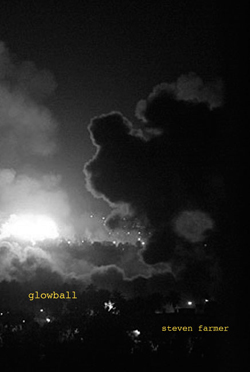 Farmer is one of those writers who just don't get published enough,
for often when I look at current events I long to find out what Steve
Farmer's take on it will be, and then ten years later, in a book like
glowball, it's still the news that makes news. He is always
inventive, and his long poems have a shapely quality to them denied
to some of his peers. Even in a traditional attraction such as the metaphor,
his are exceedingly gorgeous: I like the "greater Los Angeles area"
as a "manuscript in a parking lot." You can tell he takes
the long view: the cover is a Robert Fisk photo of US bomb activity
in Iraq, and makes it seem like the "return to immensity"
nasty old George Bataille was cheerleading for in his cold-war take
on de Sade. Well, a sort of jewel box awaits you, courtesy of Palmyra,
New York, and its mighty little theenk Books, and when you read glowball,
that it came from Palmyra will seem so apropos. –
Kevin Killian, Attention Span
Farmer is one of those writers who just don't get published enough,
for often when I look at current events I long to find out what Steve
Farmer's take on it will be, and then ten years later, in a book like
glowball, it's still the news that makes news. He is always
inventive, and his long poems have a shapely quality to them denied
to some of his peers. Even in a traditional attraction such as the metaphor,
his are exceedingly gorgeous: I like the "greater Los Angeles area"
as a "manuscript in a parking lot." You can tell he takes
the long view: the cover is a Robert Fisk photo of US bomb activity
in Iraq, and makes it seem like the "return to immensity"
nasty old George Bataille was cheerleading for in his cold-war take
on de Sade. Well, a sort of jewel box awaits you, courtesy of Palmyra,
New York, and its mighty little theenk Books, and when you read glowball,
that it came from Palmyra will seem so apropos. –
Kevin Killian, Attention Span
Hardcore afficionados of poetry that stretches the materiality of language
in surprising ways will love Steven Farmer’s glowball,
and everybody else should read it too for the challenges it offers to
overly conventional uses of language and for its insights into contemporary
globalist capitalism. glowball features five poetic sequences,
each quite different, but all of which interrogate how conditions of
language can both reveal sociopolitical conditions and enmesh people
in them. – Mark Wallace, Thinking
Again
Steve Tills's Rugh Stuff
 The
orchestration of Rugh Stuff amazes me: in terms of the music
of highly allusive, multiple voicings, as well as in conceptualization,
it is an extended poem of meta engagement. Ostensibly what could appear
a trivial framework – the game of golf – instead becomes
a viable poetic platform, morphing continually, becoming a guide to
daily life, a cause for inner dialectic, a comic song, a sea change,
a ruse, a critical perspective, all in one. Rugh Stuff picks
up where the classic, hilarious comedy of love and golf, There’s
Something about Mary, leaves off, in that the poetry everywhere
rings clear, is poised with a vulnerability just shy of self-knowing,
and in so doing, offers the extra dry in humor and martinis –
yet is always full of soberingly tender force. One master achievement
here is that the dialogic streams of intertwining multiple voices sustain
a balanced sense of continued interplay, and at such length. Anyone
who’s attempted to create such a project knows how difficult it
is to sustain the interplay at length. In that, Steve Tills’s
Rugh Stuff becomes a maximally sustained repartee between people
and language – all of it talking back continually to the sand
traps of mere self interest and over-indulgent western ways. What I
have to say next makes of tribute a contention but this must be recognized:
this book ranges widely in the western literary tradition – reading
it I was reminded over and over of nothing less than the best of prickly
Shakespearean comedy, as full of double entendre about the sexual frisson
of life and language, as any Much Ado, or happily sassy, untamed
Shrew. Rugh Stuff is just that entertainingly and
artfully done. – Chris Murray,
University of Texas at Arlington
The
orchestration of Rugh Stuff amazes me: in terms of the music
of highly allusive, multiple voicings, as well as in conceptualization,
it is an extended poem of meta engagement. Ostensibly what could appear
a trivial framework – the game of golf – instead becomes
a viable poetic platform, morphing continually, becoming a guide to
daily life, a cause for inner dialectic, a comic song, a sea change,
a ruse, a critical perspective, all in one. Rugh Stuff picks
up where the classic, hilarious comedy of love and golf, There’s
Something about Mary, leaves off, in that the poetry everywhere
rings clear, is poised with a vulnerability just shy of self-knowing,
and in so doing, offers the extra dry in humor and martinis –
yet is always full of soberingly tender force. One master achievement
here is that the dialogic streams of intertwining multiple voices sustain
a balanced sense of continued interplay, and at such length. Anyone
who’s attempted to create such a project knows how difficult it
is to sustain the interplay at length. In that, Steve Tills’s
Rugh Stuff becomes a maximally sustained repartee between people
and language – all of it talking back continually to the sand
traps of mere self interest and over-indulgent western ways. What I
have to say next makes of tribute a contention but this must be recognized:
this book ranges widely in the western literary tradition – reading
it I was reminded over and over of nothing less than the best of prickly
Shakespearean comedy, as full of double entendre about the sexual frisson
of life and language, as any Much Ado, or happily sassy, untamed
Shrew. Rugh Stuff is just that entertainingly and
artfully done. – Chris Murray,
University of Texas at Arlington
Working his way through the rough stuff of word/sound magic –
front nine, back nine, nineteenth hole and dance floor – Tills
has talleyed “almost all sublime numbers” in this book of
life on the greens, the poem that Ben, Arnold, Jack, and Tiger never
knew they’d been missing – “Ah, just tap on it, Mate.”
– Stephen Ratcliffe
Black Spring Issue 1
Poetry by Stephen Ellis, kari edwards, Jim McCrary, Steve Tills, Brent Bechtel, Catherine Daly, Chris Murray,
and Layne Russell.
Black Spring Lawrence Issue
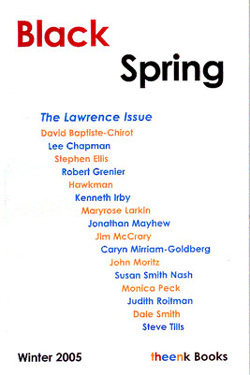
Poetry, Art, and Criticism celebrating Lawrence, Kansas, poetry community with work by Lee Chapman, Hawkman, Kenneth Irby, Jonathan Mayhew, Jim McCrary, Caryn Mirriam-Goldberg, John Moritz, Monica Peck, and Judith Roitman; essays by David Baptiste-Chirot, Stephen Ellis, Robert Grenier, Maryrose Larkin, Susan Smith Nash, Dale Smith, and Steve Tills
Steve
Tills 's Behave
 To
someone like myself, who seriously believes that poetry should be funny
even when it’s being serious, who believes that words should be
trifled with, truffled with, trod upon, sat upon, shat upon, played
with, plaid with, parlayed into other words, speyed, splayed, relayed,
decayed, flayed within a micrometer of their possible meanings &
then given mouth-to-mouth so that the whole process, the hole progress,
the holy protest can start all over again, this book is a joy. I’m
reminded of a jazz musician, has to be a sax player, someone of the
caliber of Bird or Coltrane, who starts a solo with an exquisite phrase,
returns to it, reworks it in a series of variations that build upon
themselves until a point is reached which it seems can not be gone beyond,
that it can’t get any better. & then goes & tops the whole
thing. & then moves on to the next song, where it happens all over
again. – Mark Young
To
someone like myself, who seriously believes that poetry should be funny
even when it’s being serious, who believes that words should be
trifled with, truffled with, trod upon, sat upon, shat upon, played
with, plaid with, parlayed into other words, speyed, splayed, relayed,
decayed, flayed within a micrometer of their possible meanings &
then given mouth-to-mouth so that the whole process, the hole progress,
the holy protest can start all over again, this book is a joy. I’m
reminded of a jazz musician, has to be a sax player, someone of the
caliber of Bird or Coltrane, who starts a solo with an exquisite phrase,
returns to it, reworks it in a series of variations that build upon
themselves until a point is reached which it seems can not be gone beyond,
that it can’t get any better. & then goes & tops the whole
thing. & then moves on to the next song, where it happens all over
again. – Mark Young
This book is so full of the pleasure of wit that we’ll have to
call the USDA wit-regulators to come in and stamp it with indelible
purple logos. Behave is entirely Foucault and language, combining
problematics of meta-discipline with all the possible linguistic modes
of getting to the sheer logos of wit: concision, metonymy, music, punning,
and far more. It’s like Lorca on speed and enthymeme, or Aristotle
on pheromones, or Spicer on B-12 elixir, an olive, an onion, and a wedge
of lime. Smack your lips and brain, folks, and keep on reading these
rants, I say. – Chris Murray
Steve Tills has an open heart, a good ear, and writes killer serial
poems. Rage, passion, humor, intelligence of the razorish kind, combine
and coalesce in these numbered “Rants” which come to constitute
a roiling meditative sea within which any utterance, any blood red thread
of discourse, may possibly swim. This book belongs on the same shelf
as Ed Dorn’s Abhorrences or Jim McCrary’s The
Book Of Arrogance – it’s that edgy. But – at
the same time – it is more discursive and more emotional, more
driven. Here is a man who was born to write – and, ok, to play
golf – who is flooding all available space with the formidable
searchlights of his intellect. –
Tom Beckett
Available Later This Year, 2018:
Eric Selland's Object
States,
Aldon Nielsen's YOU
DIDN’T HEAR THIS FROM ME,
Judith Roitman's Roswell,
Agnes Borgnine's The
Collected Poems of Frank Stetson,
Jane Joritz-Nakagawa's <terrain
grammar>,
Alex Gildsen's CURRENT
SEAS,
Available Later This Year, 2018, maybe, Everything Depends Upon:
Black Spring Sonoma Issue
Black Spring Prose Poetry / Hybrid Issue
Black Spring Bolinas Issue